

Two currencies, two decisions
Gold supports the current run's progression, while Silver is used for permanent purchases between attempts. Decide which problem you are solving before choosing a route or planning a purchase. Challenge completion, available currency, and ownership are separate states even when they appear beside the same locked item.
Reviewed:
The two currencies answer different questions. Gold helps the castle grow stronger during the attempt you are playing. Silver helps expand the options you can use in later attempts.
If you have collected plenty of gold but still cannot buy a module in the loadout, nothing necessarily went wrong. You may be looking at the wrong currency or an unmet unlock condition.
Compare gold and Silver
| Resource | Main use | Where to check it |
|---|---|---|
| Gold | Progress toward in-run levels and upgrade selections | The current run's progress display |
| Silver | Permanent purchases such as modules, captains and vehicles | The between-run purchase interface |
| Upgrade rarity | Describes the offered upgrade, not a currency balance | The card's effect and rarity presentation |
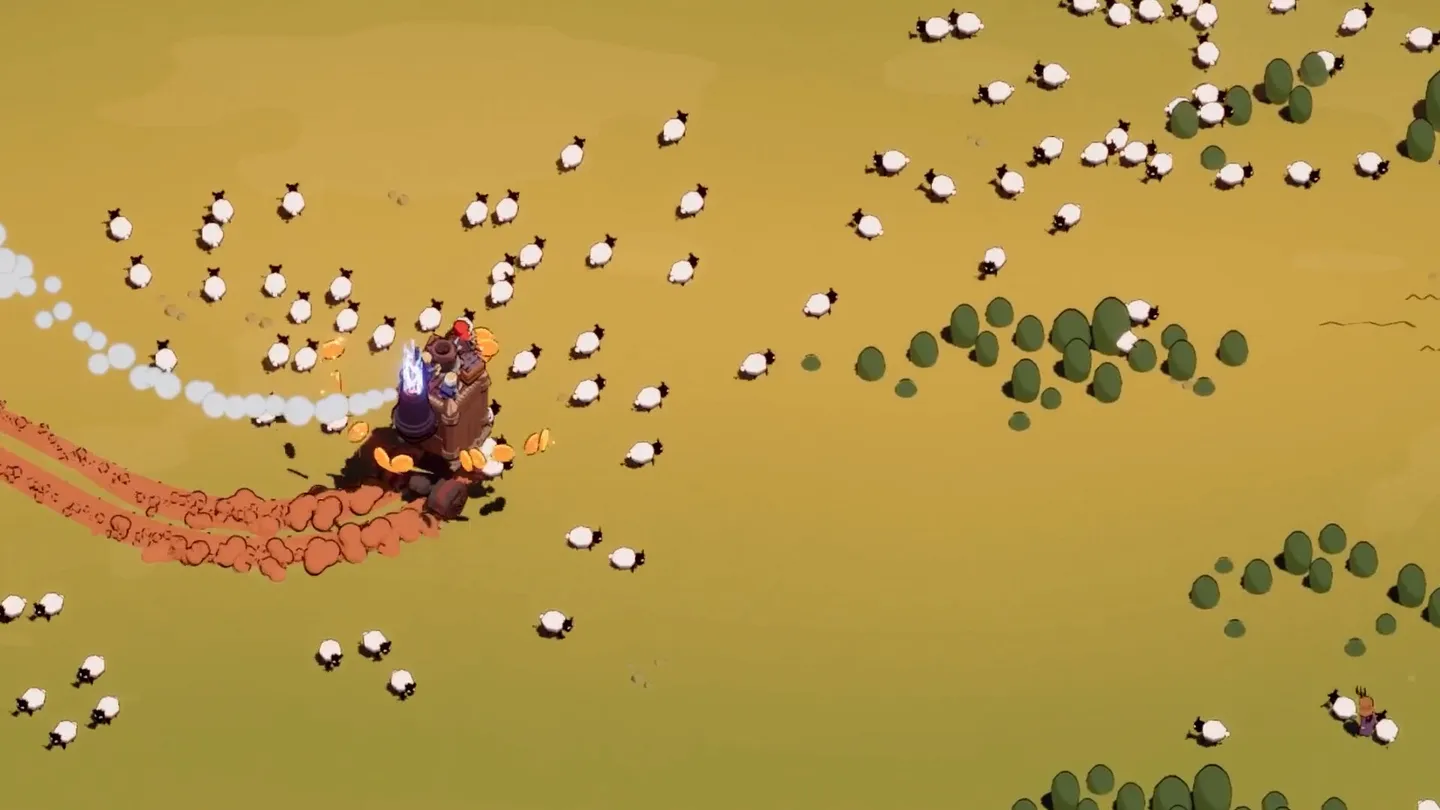
The image shows a castle collecting gold among sheep. That collection loop feeds the active run. It should not be read as a screenshot of a Silver purchase reward.
Ignore color when identifying the currency
Video commentary sometimes calls an upgrade gold or silver because of its appearance. That does not mean selecting it spends or awards that currency. Read the effect text and the counter associated with it.
There is no verified gold-to-Silver exchange formula here. Do not plan a permanent purchase by treating the run's gold total as convertible savings. Use the actual Silver reward and between-run balance.
Follow the gold loop from collection to a decision
The useful result of gathering gold is another opportunity to improve the castle during the attempt. In the recorded early gameplay, collecting resources leads into an upgrade selection for the equipment currently available. That connection explains why a route through accessible resources can matter before committing to a difficult enemy. The route is valuable when it produces improvements that help you survive what comes next.
The resource total alone does not decide whether the run is going well. A player can reach several selections and repeatedly choose effects that do little for the attacks actually being used. Another player can take a relevant automatic upgrade or a useful active change and gain more practical benefit from fewer choices. Read the result of the selection, rather than treating the act of collecting as the entire progression plan.
This is also why gold and module levels should not be treated as identical counters. Gold contributes to opportunities, while individual choices determine which equipment receives attention. If an objective refers to a particular module level, use the relevant upgrades to pursue it. Gathering resources is part of that plan, but it does not guarantee the needed card appears at each selection.
Choose a collection route you can survive
Look at the route to a resource, the threat around it, and the route away. A nearby group of resources is less attractive when reaching it pins the castle against danger. Conversely, ordinary resources in open space can help build momentum without demanding a long fight. The recommendation is to connect collection with safe movement, not to memorize an unsupported perfect opening path.
After the castle grows or the enemy pressure changes, reevaluate the same route. A turn that was comfortable earlier can become awkward in a more crowded encounter. Keep enough space to maneuver and avoid repeatedly driving through an attack merely because coins remain behind it. Those resources cannot support another upgrade if the attempt ends before you can make use of them.
A gold-income choice has the same practical limitation. It may help the current run progress, but it competes with other offered benefits. If your immediate problem is surviving a dangerous encounter, more income may arrive too late to solve it. Consider how much room the present build has to turn future selections into strength before choosing an economy effect on habit.
Plan Silver around a specific purchase
Before setting out to earn Silver, inspect the option you want to buy. Read its name, the displayed price, any unmet challenge, and the slot or role it fills. This turns a vague goal of earning more currency into a concrete progression step. It can also reveal that currency is not the current blocker at all: the condition might still be incomplete, or the item might not fit the selected chassis.
Then identify the smallest complete setup that would make the purchase useful. Buying a specialist captain before owning appropriate modules can leave the new option difficult to use. Buying a compatible module that fills a missing role can immediately broaden your choices. The first module purchase guide connects this decision to the slots you can equip.
The archived Early Access advice favors module purchases for variety, while the gameplay also shows captains, crews, artifacts, and vehicles creating different playstyles. Both observations matter. A module purchase can address a narrow selection pool; another kind of purchase can support a clear goal you already have. Choose for the next playable setup instead of assuming every permanent option is an unconditional power increase.
Read objective wording before choosing a farming attempt
The recorded material includes objectives tied to actions such as consuming units and destroying vehicles. Some wording specifies a single run, which changes the plan: small amounts of progress across separate attempts cannot simply be assumed to satisfy that condition. Other objectives may be cumulative. The reliable approach is to read the actual current wording before deciding how to pursue the reward.
Choose an objective that your available equipment can support. If you need ordinary run progress, a manageable stage can give you more opportunities to finish an objective than repeatedly entering a difficult area that ends the attempt early. The recommendation in the archived advice is to pay attention to those objectives rather than assuming higher difficulty automatically produces the most useful early income.
The Silver farming guide develops that objective-based approach. There is no controlled comparison establishing the best stage for Silver per minute. Here, the practical criterion is whether you can reliably complete the relevant action and use the reward toward the intended purchase.
Revisit boss locations for the right reason
Hotfix 0.9.9 made boss tombstones collectible and added Silver drops to them. This matters because defeating the boss and collecting the reward are different actions. If you immediately steer away from the location, inspect whether the reward remains available and whether there is a safe route back. Do not assume that every visible coin elsewhere represents the same kind of reward.
The patch does not specify a single amount for every boss in every situation. It also does not establish how much Silver you should earn over an entire route. Use the change as a reason to check the boss location, not as a basis for multiplying an invented reward by a planned number of kills. A named reward mechanism is more useful than a precise-looking total unsupported by the game information.
Safety still matters when returning. If another threat occupies the area, choose a route that lets you collect without giving up your escape. If the attempt is already in serious danger, do not let a small visible reward override the actions that could keep you alive. This is a play recommendation, and its value depends on the actual battlefield rather than a universal rule about always turning back.
Treat Overtime income as a survival question
The archived runs show Silver rewards during extended play after the main boss sequence. They also show those attempts ending under increasing pressure. A successful boss clear therefore does not prove that the same build can safely continue for a long time. Movement, recovery, and the ability to deal with continuing threats remain relevant after the original objective is complete.
Do not copy a displayed earnings rate from one moment and apply it to the whole run. That number belongs to the circumstances shown, and the footage does not establish an identical rate for every account, stage, or patch. Likewise, one large final reward does not prove that every minute of the attempt was the fastest possible way to earn Silver.
For a new account, compare the time and reliability of an unfinished objective with the difficulty of staying alive longer. For an established build, additional play may be a reasonable way to combine practice with progression. In either case, keep the goal explicit. A challenging survival attempt and an efficient next-purchase attempt can be worthwhile for different reasons without being the same optimization problem.
Resolve the three common purchase failures
If the item still shows a lock, begin with the condition rather than the wallet. Check whether the requested stage, module level, or other action actually matches what you completed. Similar names and nearby difficulty levels are not interchangeable. Do not add an extra requirement because a purchase failed; first establish which displayed requirement is still unmet.
If the condition is complete but the purchase remains unaffordable, compare the Silver price with the Silver balance. Gold collected during the previous run is not a substitute balance. Avoid using a spoken video total as proof of what your account should contain. The between-run interface is where the next purchase can be checked against the currency it actually uses.
If the item has been purchased but cannot be equipped where expected, inspect the loadout. A module belongs to a slot, and the chassis determines which positions are available. This is a compatibility problem rather than a need to farm more Silver. The purchase, the equipment selection, and the later random offer are separate events; determine which event has not happened before repeating the whole progression loop.
Keep a short record of what the next run should achieve
Before starting, write down the desired purchase and the current blocker in ordinary language: finish the displayed condition, earn the remaining Silver, or select equipment that fits the chassis. During the attempt, let gold support the immediate upgrades needed to stay alive and pursue that objective. Afterward, return to the purchase interface and confirm what changed.
This makes progress easier to interpret without inventing a currency conversion or a guaranteed farming route. A failed clear can still complete a relevant objective; a long successful run can still leave a particular condition unfinished. The correct question is which requirement moved forward, not whether one prominent total looked larger than before.
Gold during the run
Gold contributes to the run's upgrade progression. The immediate question is whether collecting it gives the current castle enough useful upgrades without exposing it to more damage than it can manage. More opportunities matter when they improve equipment you are using. Gold income does not itself prove that a permanent purchase is affordable after the run ends.
Partially verifiedSilver between attempts
Silver is used for permanent options such as modules, artifacts, captains, crews, and vehicles. Having enough currency is only one part of access: inspect the specific item's challenge and purchase state. A new option can change how you play without being an unconditional increase in strength. Choose purchases for a loadout you can actually equip.
Partially verifiedCollectible boss tombstones
Hotfix 0.9.9 made boss tombstones collectible and added Silver drops to them. After a boss falls, inspect its location and look for a safe collection opportunity. The patch does not establish a universal amount, a per-minute income rate, or a reason to drive through lethal attacks for a reward. Collection and defeating the boss remain distinct observations.
ConfirmedProgression checks before another attempt
These sequences connect a failed purchase or weak run to the next useful check. They are planning routes rather than combat combos; no frame timings are asserted. Follow the route that matches the visible state of the item and the type of progress you actually need.